The true price of silver

The price you pay for physical silver may be higher than the silver spot price given by our calculator. The silver spot price is dictated by paper contracts that trade on the COMEX and other major futures exchanges. These contracts may have little or no relationship with actual physical silver bullion inventories. For example the total open position of silver contracts on the COMEX are approximately nine times as large as the total physical inventory of the COMEX and about 156% the world's total mine production. Future settlement of significant short position could create significant demand for physical silver.

Should I buy or sell silver?

At today's price of $34 an ounce silver has fallen 31% from its all time high of $49. Will the price now rise or fall?

One way to look at the value of silver is to compare it to gold. Over the past forty years, silver has averaged roughly 1/55th the price of gold. At the end of April, silver’s ratio to gold hit a 30 year high of 1-to-30, the highest since 1980. Today, with the price of gold at $1,723 an ounce silver’s ratio is about 1-to-51. If silver reverts back to its traditional ratio versus gold, you would expect silver to trade at around $31 an ounce. Further back in time silver's ratio to gold was 1-to-16. This is in fact the ratio of silver to gold in the earth's crust. If silver were to revert to this ratio you would expect silver to trade at around $108 an ounce.

A popular method used by traders and financial institutions for predicting future trends is the moving average. If the price is above the moving average then this indicates an upward trend.

Another important indicator is real interest rates. Real interest rates are calculated by taking the nominal rate of interest and subtracting inflation. When real interest rates are below zero, cash and short-term investments lose money.As a result, savers turn to gold and silver and the prices of the metals go up. When real interest rates are positive, metal prices goes down.Inflation is currently 2.91% and short-term interest rates are 0.77%, so real interest rates are -2.14% which is also good for precious metals. Also check on what the big hedge fund managers are doing.

It is also worth noting that the price of silver is in backwardation. Backwardation is a situation where the spot price of a commodity is higher than the forward futures price. Generally, the price of a commodity is more expensive in the future because of storage costs – and that situation is called Contango. Contango is the usual situation, and Backwardation is somewhat unusual, as it means that a premium is being paid to own a commodity now rather than in the future – and it often means there is a shortage of that commodity. On the other hand the backwardation could be caused by large silver producers hedging their forward production to lock in future profits.

Facts about Silver

Silver is a white, lustrous metal valued for its decorative beauty and electrical conductivity. It has long been valued for its white metallic lustre, its ability to be readily worked, and its resistance to the corrosive effects of moisture and oxygen. The lustre of the pure metal is due to its electron configuration, which results in its reflecting all electromagnetic radiation of wavelengths shorter than 3000 angstroms.

Symbol
Ag
atomic number
47
atomic weight
107.868
melting point
960.8° C (1,861.4° F)
boiling point
2,212° C (4,014° F)
specific gravity
10.5 (20° C)
oxidation states
+1, +2
electronic config
[Kr]4d105s1
rarity
0.05 parts per million of the Earth's crust
crystal structure
cubic, face centered
density
10.49 grams per cubic centimetre
hardness
2.5 to 2.7

Silver is located in Group Ib Period 5 of the periodic table, between copper (Period 4) and gold (Period 6), and its physical and chemical properties are intermediate between those two metals. With a density of 10.49 grams per cubic centimetre, it is the lightest of the precious metals. It is also the least noble of the precious metals, reacting readily with many common reagents such as nitric acid and sulfuric acid. Metallic silver can be dissolved from gold alloys of less than 30 percent gold by boiling with 30-percent-strength nitric acid in a process referred to as parting. Boiling with concentrated sulfuric acid to separate silver and gold is called affination.

Silver has been known and valued as an ornamental and coinage metal since ancient times. It was discovered after gold and copper about 4000 BC, when it was used in jewelry and as a medium of exchange. The earliest known workings of significant size were those of the pre-Hittites of Cappadocia in eastern Anatolia. Silver mines in Asia Minor were probably worked before 2500 bc. The alchemists called the metal Luna or Diana after the goddess of the moon and ascribed to it the symbol of a crescent moon.

The element’s name comes from the Anglo-Saxon word for the metal.With the exception of gold, silver is the most malleable and ductile of all metals. Its hardness ranges between 2.5 and 2.7; it is harder than gold but softer than copper. Silver melts at about 962°C (about 1764°F), boils at about 2162°C (about 3924°F), and has a specific gravity of 10.5. The atomic weight of silver is 107.868.

Properties and uses

Chemically silver is not very active. It is insoluble in dilute acids and in alkalies but dissolves in concentrated nitric or sulfuric acid, and it does not react with oxygen or water at ordinary temperatures. Sulfur and sulfides attack silver, and tarnishing is caused by the formation of silver sulfide on the surface of the metal. Eggs, which contain a considerable quantity of sulfur as a constituent of protein, tarnish silver extremely quickly. Small amounts of sulfide, which occurs naturally in the atmosphere and which, as hydrogen sulfide (H2S), is added to natural gas used domestically, tarnish silver. The black silver sulfide (AG2S) is among the most insoluble salts in aqueous solution, a property that is exploited for separating silver ions from other positive ions.

Silver is the best electrical and thermal conductor of all metals and so is used in many electrical applications, particularly in conductors, switches, contacts and fuses and fabricating printed electrical circuits and as a vapour-deposited coating for electronic conductors; it is also alloyed with such elements as nickel or palladium for use in electrical contacts. .Contacts provide junctions between two conductors that can be separated and through which current can flow, and account for the largest proportion of electrical demand. The most significant uses of silver in electronics are in the preparation of thick-film pastes, in multi-layer ceramic capacitors, in the manufacture of membrane switches, silvered film in electrically heated automobile windshields and in conductive adhesives. Silver used in the fabrication of photo voltaic cells is seen as an area of rapid growth in the short to medium term. Other industrial uses for silver include as a coating material for compact disks and digital video disks, mirrors, glass coatings and cellophane and batteries. Silver also finds use as a catalyst for its unique ability to convert ethylene to ethylene oxide, which is a precursor of many organic compounds.

Together with gold, and the platinum-group metals, silver is one of the so-called precious metals. Because of its comparative scarcity, brilliant white colour, malleability, and resistance to atmospheric oxidation, silver has long been used in the manufacture of coins, ornaments, and jewelry. Silver ornaments and decorations have been found in royal tombs dating back as far as 4000 BC. It is probable that both gold and silver were used as money by 800 BC in all countries between the Indus and the Nile.

Historically, a major use of silver has been monetary, in the form of reserves of silver bullion and in coins. By the 1960s, however, the demand for silver for industrial purposes, in particular the photographic industry, exceeded the total annual world production.

Silver is used in industrial and manufacturing application due to its strength, malleability and ductility, electrical and thermal conductivity, sensitivity to and high reflectance of light and its ability to endure extreme temperature ranges. Industrial uses of silver can range from high tech applications, including medical equipment, to plumbing hardware. Silver is also used as a catalyst for the manufacture of commonly used chemicals such as ethylene oxide and formaldehyde. Many batteries are also manufactured with silver alloys, due to silver's superior power-weight characteristics, although silver-oxide batteries are now beginning to be replaced with lithium-ion batteries in cellular phones and lap-top computers, due to environmental and safety concerns. Silver is also used in the manufacturing of mirrors and lenses. Silver's light reflective ability allows it to be used as an energy efficient glaze and for ultraviolet filtering in eye glasses. Silver paints and coatings are used in circuit boards to utilize silver's conductive properties and in medical applications due to silver's anti-bacterial qualities.

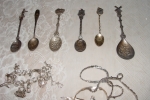
 Consumer uses of silver, such as the fabrication of jewelry and silverware, utilize silver's lustre, resistance to tarnishing and malleability. Silver is a visibly clean, attractive and strong metal ideal for contact with food and mouth. It is one of the most chemically inert of metals and does not react with acids present in fruit, fish and sauces, etc. Hence, it is a popular choice for making tableware (cutlery, flatware and hollowware) for daily use such as dinner knives, forks and spoons, serving dishes, drinking vessels, tea and coffee services. Use of the metal for sterling and plated silverware, ornaments, jewelry, and similar products has continued to be important. Alloys of silver with copper are harder, tougher, and more fusible than pure silver and are used for jewelry and coinage. The proportion of silver in these alloys is stated in terms of fineness, which means parts of silver per thousand of the alloy. Sterling silver contains 92.5 percent of silver and 7.5 percent of another metal, usually copper; i.e., it has a fineness of 925. Jewelry silver is an alloy containing 80 percent silver and 20 percent copper (800 fine). Gold dental alloys contain about 75 percent gold and 10 percent silver. The yellow gold that is used in jewelry is composed of 53 percent gold, 25 percent silver, and 22 percent copper.

Colloidal silver, dilute solutions of silver nitrate (AgNO3), and some insoluble compounds, such as potassium, are used in medicine as antiseptics and bactericides. Argyrol, a silver-protein compound, is a local antiseptic for the eyes, ears, nose, and throat. However taking the wrong kind of silver water in excessive amounts can turn you blue. Collodial silver water consists of nano particles of silver and will never turn you blue

The silver-halide salts—silver bromide, silver chloride, and silver iodide—which darken on exposure to light, are used in emulsions for photographic plates, film, and paper. The salts are soluble in sodium thiosulfate, which is the compound used in the photographic fixing process

Natural silver consists of a mixture of two stable isotopes: silver-107 and silver-109. The metal does not react with moist air or dry oxygen but is oxidized superficially by moist ozone. It is quickly tarnished at room temperature by sulfur or hydrogen sulfide. In the molten state, silver can dissolve up to 22 times its volume of oxygen; on solidification, most of the oxygen is expelled, a phenomenon known as the spitting of silver. This can be controlled by the addition of a deoxidant such as charcoal to the molten silver. Silver dissolves readily in nitric acid and in hot concentrated sulfuric acid.

Occurrence

Silver is widely distributed in nature, but the total amount is quite small when compared with other metals; the metal constitutes 0.05 parts per million of the Earth's crust.

Unlike gold, silver is present in many naturally occurring minerals. The most abundant include argentite (Ag2S) and tetrahedrite. Deposits of native (chemically free, or uncombined) silver are also commercially important.

Because the majority of the ores that contain silver also contain the important metals lead, copper, or zinc or a combination of the three, the silver-bearing fraction of these ores is frequently recovered as a by-product of copper and lead production. Pure silver is then recovered from the crude fraction by a combination of smelting and fire- or electrorefining.

Silver ranks about 66th among elements in natural abundance in crustal rocks. It occurs in the pure state to a small extent; the most notable deposits of native silver are in Peru and Norway, where the mines have been worked for centuries. Pure silver is also found associated with pure gold in the form of an alloy known as electrum, and considerable amounts are recovered in the processing of gold. Silver is usually found combined with other elements (of which sulfur is the most predominant) in minerals and ores. Practically all sulfides of lead, copper, and zinc contain some silver. Silver-bearing ores may contain amounts of silver from a trace to several thousand troy ounces per avoirdupois ton, or about 10 percent.Some of the important silver minerals are cerargyrite (or horn silver), pyrargyrite, sylvanite, and argentite. Silver also occurs as a constituent of lead, copper, and zinc ores, and half the world production of silver is obtained as a by-product in the processing of such ores. Practically all the silver produced in Europe is obtained from the lead sulfide ore, galena. In the United States relatively few mines are worked for their silver alone—the silver is mined in conjunction with lead, copper, and zinc. In 2004, U.S. mines produced 1,250 metric tons of silver, about one-eighth of the production worldwide. Most of the silver mined in the world comes from Mexico, the United States, Peru, Australia, and Canada. The leading silver-producing states in the United States are Nevada, Idaho, Alaska, and Arizona.

Compounds

In the vast majority of silver compounds the element has an oxidation state of +1. These compounds include such familiar substances as silver chloride (AgCl), silver bromide (AgBr), and silver iodide (AgI). Each of these salts is used extensively in photography. Silver chloride serves as the light-sensitive material in photographic printing papers and, together with silver bromide, in certain films and plates. The iodide is also used in the manufacture of photographic papers and films, as well as in cloud seeding for artificial rainmaking and in some antiseptics. All three halides are derived from silver nitrate (AgNO3), which is the most important of the inorganic silver salts. Besides these other salts, silver nitrate is also the starting material for the production of the silver cyanide used in silver

How to Identify Sterling Silver Flatware

Sterling silver flatware can be tricky to identify, which is why it’s best to bring it to an expert. Three simple rules will help you identify sterling silver.

1. Most flatware is silver plated: Just because your flatware is old and tarnished, does not mean it is sterling silver!  Silver plating is a very thin layer of silver that is placed over another metal, silver plate flatware holds no real value.

A list of some hallmarks (Imprinting on the flatware that identifies what it is composed of):

  • Silver Plate Hallmarks: EPMS, Silver Plate, Quadruple Plate, Double Plate, Alpaco Silver, Plate, and Heavy Plate.
  •  Silver Marks: Coin Silver (90% Silver), Sterling Silver (92.5%), 952, 700, 800, and Fine Silver (99.9%). Flatware that is identified as silver can be sold for a substantial amount of money.

2. Heavy or light: Most sterling silver flatware is surprisingly light. The most common sterling flatware is made of very thin sheets of silver. If your flatware is really heavy, it is most likely silver plated. The heavy metals used beneath the silver plating are usually bulky and heavy; however, some of the highest quality sterling flatware is heavy.

3. Rare patterns: Your set of flatware may be worth much more than melt value. Collectors place a high value in rare and desirible patterns. I recommend always taking your sterling sets to a expert that has experience selling rare sets.


The Total Supply of silver continues to rise

World Silver Supply and Demand
(in millions of ounces)
  2000 2001 2002 2003 2004 2005 2006 2007 2008 2009
Supply
Mine Production 591.0 606.2 593.9 596.6 613.0 636.8 640.9 664.4 684.7 709.6
Net Government Sales 60.3 63.0 59.2 88.7 61.9 65.9 78.2 42.5 27.6 13.7
Old Silver Scrap 180.7 182.7 187.5 183.9 183.7 186.0 188.0 181.8 176.0 165.7
Producer Hedging -- 18.9 -- -- 9.6 27.6 -- -- -- --
Implied Net Disinvestment 87.1 -- 12.6 -- -- -- -- -- -- --
Total Supply 919.1 870.9 853.1 869.3 868.2 916.3 907.2 888.7 888.3 889.0
 
Demand
Industrial Applications 374.2 335.6 340.1 350.8 367.6 407.0 427.0 456.1 443.4 352.2
Photography 218.3 213.1 204.3 192.9 178.8 160.3 142.4 124.8 104.9 82.9
Jewelry 170.6 174.3 168.9 179.2 174.8 173.8 166.3 163.5 158.3 156.6
Silverware 96.4 106.1 83.5 83.9 67.2 67.5 61.0 58.4 56.9 59.5
Coins & Medals 32.1 30.5 31.6 35.7 42.4 40.0 39.8 39.7 65.2 78.7
Total Fabrication 891.7 859.4 828.3 842.4 830.8 848.7 836.4 842.5 828.6 729.8
Producer De-Hedging 27.4 -- 24.8 20.9 -- -- 6.8 24.2 11.6 22.3
Implied Net Investment -- 11.4 -- 6.0 37.4 67.6 64.0 22.0 48.2 136.9
Total Demand 919.1 870.9 853.1 869.3 868.2 916.3 907.2 888.7 888.3 889.0
 
Silver Price
(London US$/oz)
4.953 4.370 4.599 4.879 6.658 7.312 11.549 13.384 14.989 14.674


Search our database for buyers and sellers of silver: